
Sarnath Tour Package from Varanasi
Sarnath | Where Buddha Gave His First Sermon — Complete History & Travel Guide
Discover Sarnath’s Buddhist history — from Buddha’s first sermon and the Dhammacakkappavattana Sutta to Emperor Ashoka’s Lion Capital — plus everything you need for your Sarnath tour from Varanasi with ShriKashiTrip.
- Distance from Varanasi10-13 km, 25-45 minutes by taxi
- Site Timings6:00 AM – 6:00 PM daily
- Museum Timings9:00 AM – 5:00 PM, closed Fridays
- Entry Fee₹25 (Indian) / ₹300 (foreign national)
- Recommended Visit3-4 hours
- Best Time to VisitOct–Mar, 6-9 AM or 4-6 PM
Sarnath: The Birthplace of Buddhism’s First Teaching
Sarnath is one of Buddhism’s four most sacred pilgrimage sites — alongside Lumbini (birth), Bodh Gaya (enlightenment), and Kushinagar (mahaparinirvana). It was here, in what was then known as Isipatana or Mrigadava (the Deer Park), that Siddhartha Gautama delivered his first sermon after attaining enlightenment, turning Sarnath into the birthplace of the Buddhist Sangha — the community of ordained monks. For anyone travelling to Varanasi, a Sarnath Buddhist history tour is one of the most meaningful half-day trips available.
The History of Buddha’s First Sermon at Sarnath
After attaining enlightenment beneath the Bodhi tree at Bodh Gaya around 528 BCE, the Buddha spent seven weeks in quiet retreat before deciding to share what he had realised. He travelled to the Deer Park at Isipatana, near Varanasi, to find the five ascetics — his former companions — with whom he had once practised extreme austerity.
In that Deer Park, the Buddha delivered his historic first discourse, known as the Dhammacakkappavattana Sutta — “Setting in Motion the Wheel of Dharma.” This sermon introduced the core framework of Buddhist philosophy: the Four Noble Truths and the Noble Eightfold Path. As the Buddha spoke, one of the five ascetics, Kondanna, attained the first stage of enlightenment — becoming the Buddha’s first disciple. The remaining four followed over the next several days, and together they formed the first Sangha.
This single event at Sarnath is considered the true starting point of Buddhism as an organised spiritual tradition — the moment the “Wheel of Dharma” began turning, a symbol still found today on the Ashoka Chakra at the centre of the Indian flag.
Emperor Ashoka, the Ashoka Pillar & the Lion Capital
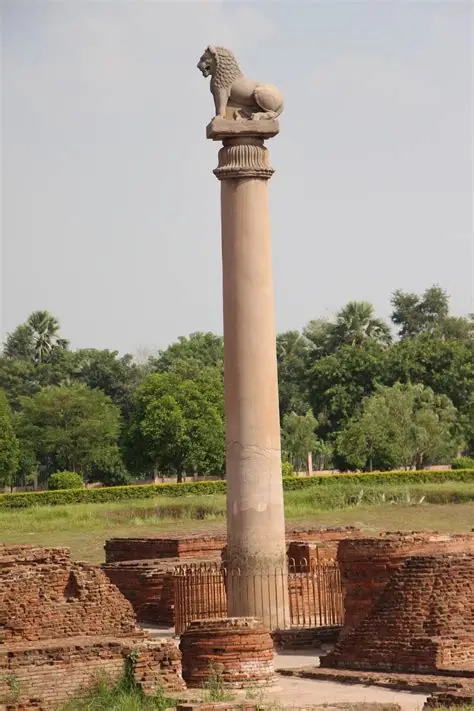
Nearly 250 years after Buddha’s first sermon, the Mauryan Emperor Ashoka — deeply moved by Buddhist teachings after the bloody Kalinga war — transformed Sarnath into a major centre of Buddhist worship and learning. Around 250 BCE, he erected a tall sandstone pillar at the exact spot of the first sermon, inscribed with his edicts promoting non-violence, tolerance and moral governance.
The pillar was originally crowned by the now-famous Lion Capital of Ashoka — four Asiatic lions seated back-to-back, carved from a single block of polished Chunar sandstone. The pillar was broken during 12th-century invasions that destroyed many Buddhist monuments across India, but the Lion Capital survived largely intact and was rediscovered during archaeological excavations in 1904-05.
On 26 January 1950, independent India formally adopted the Lion Capital as the National Emblem of India, and the 24-spoke Dharma Chakra from its base was placed at the centre of the Indian national flag — meaning that a piece of Sarnath’s Buddhist heritage sits at the very core of India’s national identity today.
From Golden Age to Ruins — Sarnath’s Later History
Under later dynasties, Sarnath continued to flourish as a centre of Buddhist scholarship, with Chinese pilgrim travellers Faxian (5th century CE) and Xuanzang (7th century CE) both recording detailed descriptions of its towering stupas and monasteries in their travel accounts. However, the site was largely destroyed during 12th-century invasions and gradually faded into obscurity, buried under centuries of neglect.
It wasn’t until the early 1800s that archaeologists began serious excavation of the site, culminating in Sir John Marshall’s Archaeological Survey of India excavations of 1904-05, which uncovered the Ashoka Pillar, the Lion Capital, and the foundations of numerous ancient stupas and monasteries — artefacts that are now preserved in the Sarnath Archaeological Museum, the first site museum ever built by the ASI.
Top Places to Visit in Sarnath
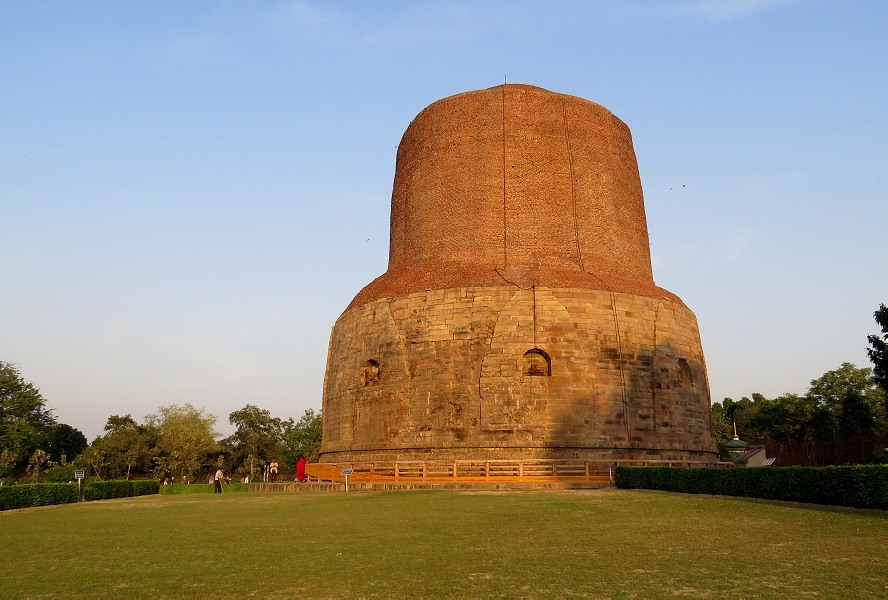
Dhamek Stupa
A 43.6-metre cylindrical stone monument marking the precise spot of Buddha’s first sermon — the most iconic structure in Sarnath.
Ashoka Pillar
The surviving fragment of Emperor Ashoka’s original pillar, still standing near the Dhamek Stupa at its authentic 250 BCE location.
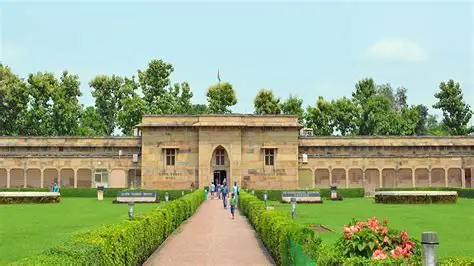
Sarnath Archaeological Museum
Home to the original Lion Capital of Ashoka — India’s National Emblem — along with hundreds of Buddhist sculptures and artefacts from the site.
Mulagandha Kuti Vihar
The main modern temple at Sarnath, famous for its frescoes depicting scenes from Buddha’s life.
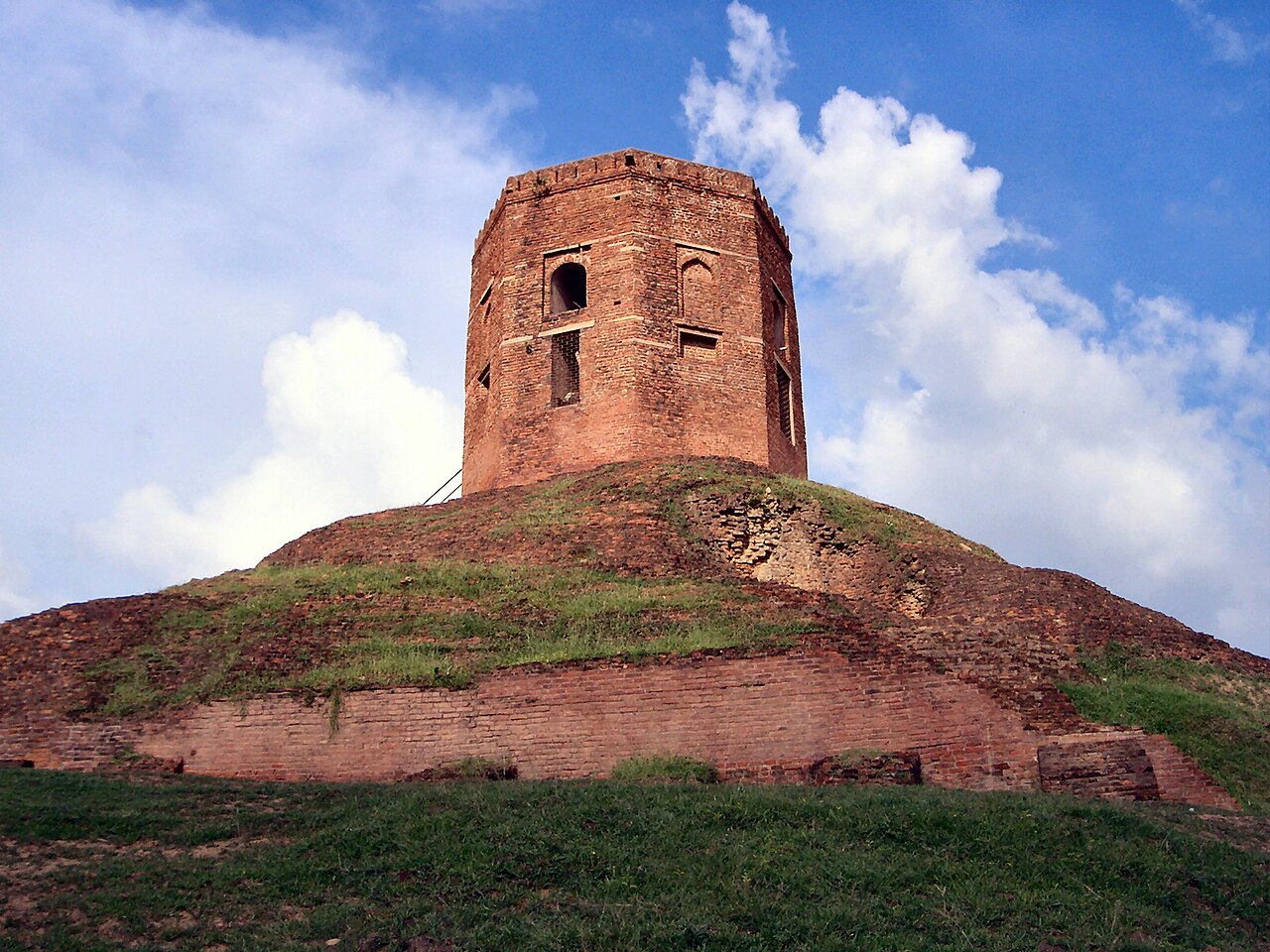
Chaukhandi Stupa
A terraced brick structure marking the spot where Buddha is believed to have met his five former companions before delivering his first sermon.
Deer Park (Isipatana)
The peaceful, tree-lined grounds where the entire historic event unfolded — still home to deer today.
International Buddhist Temples
Including the Japanese, Thai, and Tibetan monasteries, each showcasing a different national style of Buddhist architecture.
Sarnath Timings & Entry Fee
| Site | Timings |
|---|---|
| Dhamek Stupa & archaeological site | 6:00 AM to 6:00 PM daily |
| Mulagandha Kuti Vihar | 6:00 AM to 7:00 PM, with a special evening chanting session |
| Sarnath Archaeological Museum | 9:00 AM to 5:00 PM — closed every Friday |
Entry fee: Archaeological zone approx. ₹25 for Indian nationals, ₹300 for foreign nationals; museum ticket around ₹5-25. Most Buddhist temples inside Sarnath have no entry fee.
Recommended visit duration: 3-4 hours for a complete, unhurried visit. Best time to visit: Early morning (6:00-9:00 AM) or late afternoon (4:00-6:00 PM), October to March for the most comfortable weather.
Tip: Avoid visiting on a Friday if you want to see the Lion Capital — the museum stays closed, though the stupa and Ashoka Pillar remain open.
A Typical Half-Day Sarnath Tour, Step by Step
Pickup from Varanasi
Our cab picks you up from your hotel, ghat area, airport or railway station for the 25-45 minute drive to Sarnath.
Chaukhandi Stupa & Dhamek Stupa
Begin where Buddha met his five companions, then walk to the Dhamek Stupa — the exact site of the first sermon.
Ashoka Pillar & Museum
View the surviving Ashoka Pillar fragment, then see the original Lion Capital inside the Archaeological Museum (closed Fridays).
Mulagandha Kuti Vihar & Deer Park
Visit the frescoed modern temple and the peaceful Deer Park before exploring the Japanese, Thai and Tibetan monasteries.
Return or Combine
Head back to Varanasi, or continue straight on to Kashi Vishwanath darshan and the evening Ganga Aarti.
Varanasi to Sarnath Distance & Taxi Fare
Distance: approximately 10-13 km from central Varanasi. Travel time: 25-45 minutes by taxi, depending on traffic near the Cantt area. From Varanasi Airport: around 12 km, roughly 25-30 minutes by cab.
| Cab Type | One-Way Fare (approx.) | Round Trip Fare (approx.) |
|---|---|---|
| Sedan (Dzire/Etios) | ₹600 – ₹800 | ₹1,200 – ₹1,500 |
| Innova / Innova Crysta | ₹900 – ₹1,200 | ₹1,800 – ₹2,500 |
| Full-Day Cab (Sarnath + Varanasi circuit) | — | ₹2,999 – ₹4,499 |
Round-trip bookings, where the driver waits at Sarnath during your visit, are the most cost-effective option. Contact us for the latest confirmed rate.
Sarnath & the Wider Buddhist Circuit
Sarnath is the natural starting or ending point of India’s four-site Buddhist pilgrimage circuit, alongside Lumbini in Nepal (birthplace), Bodh Gaya in Bihar (enlightenment site, roughly 250 km from Varanasi), and Kushinagar in Uttar Pradesh (site of Buddha’s mahaparinirvana). Many pilgrims combine a Sarnath visit with a longer multi-day Buddhist circuit tour, and ShriKashiTrip can help arrange onward taxi connections for Bodh Gaya and Kushinagar as part of an extended itinerary.
Why Book Your Sarnath Tour with ShriKashiTrip
- ✅ Drivers experienced with Sarnath’s site layout and Friday museum closure
- ✅ Round-trip service — cab waits while you explore the ruins, museum and temples at your own pace
- ✅ Easy to combine with Kashi Vishwanath darshan or the Subah-e-Banaras morning experience in one day
- ✅ Transparent pricing — no last-minute surge charges
- ✅ Airport and railway station pickup available for direct Sarnath transfers
Sarnath — Frequently Asked Questions
Why is Sarnath important in Buddhism?
Sarnath is where Buddha delivered his first sermon after enlightenment, the Dhammacakkappavattana Sutta, introducing the Four Noble Truths and forming the first Buddhist Sangha — making it one of Buddhism’s four most sacred pilgrimage sites.
What is the Dhammacakkappavattana Sutta?
It is the name of Buddha’s first sermon, meaning “Setting in Motion the Wheel of Dharma,” delivered at the Deer Park in Sarnath to five ascetics who became his first disciples.
What are the Four Noble Truths taught at Sarnath?
The Four Noble Truths — the existence of suffering, its cause, its cessation, and the path leading to its cessation — form the foundational teaching Buddha gave during his first sermon at Sarnath.
What is the significance of the Ashoka Pillar at Sarnath?
Emperor Ashoka erected the pillar around 250 BCE at the exact site of Buddha’s first sermon. Its Lion Capital was later adopted as India’s National Emblem in 1950, and its Dharma Chakra wheel appears on the Indian national flag.
Why did Sarnath decline as a Buddhist centre?
Sarnath flourished for centuries but was largely destroyed during 12th-century invasions that targeted Buddhist monuments across India, after which the site was buried and forgotten until archaeological excavations began in the early 1900s.
How far is Sarnath from Varanasi?
Sarnath is approximately 10-13 km from central Varanasi, roughly a 25-45 minute drive by taxi depending on traffic.
What is the entry fee for Sarnath?
The archaeological zone entry fee is around ₹25 for Indian nationals and ₹300 for foreign nationals. The museum ticket costs approximately ₹5-25. Most Buddhist temples in Sarnath have no entry fee.
What are the Sarnath museum timings?
The Sarnath Archaeological Museum is open from 9:00 AM to 5:00 PM and remains closed every Friday.
How much time is needed for a Sarnath tour?
A complete Sarnath visit takes about 3-4 hours, covering the Dhamek Stupa, Ashoka Pillar, museum, Chaukhandi Stupa, and Mulagandha Kuti Vihar.
What is the taxi fare from Varanasi to Sarnath?
A Sedan one-way fare is approximately ₹600-800, while a round trip with waiting time ranges from ₹1,200-1,500. Innova fares are slightly higher.
Can I combine Sarnath with a Kashi Vishwanath darshan on the same day?
Yes, this is a very popular combination — Sarnath in the morning followed by Kashi Vishwanath darshan and evening Ganga Aarti. See our Kashi Vishwanath darshan guide for timing details.
Where is the Lion Capital of Ashoka kept today?
The original Lion Capital is preserved and displayed inside the Sarnath Archaeological Museum, close to where it was excavated in 1904-05.
What was Sarnath called in ancient times?
Sarnath was known as Isipatana or Mrigadava (Deer Park) in ancient Buddhist texts, meaning “the landing place of the sages.”
Is Sarnath part of the Buddhist pilgrimage circuit?
Yes, Sarnath is one of Buddhism’s four major pilgrimage sites, alongside Lumbini (birth), Bodh Gaya (enlightenment), and Kushinagar (mahaparinirvana).
What is the best time to visit Sarnath?
Early morning (6:00-9:00 AM) or late afternoon (4:00-6:00 PM) offer the best light and fewer crowds. October to March is the most comfortable season weather-wise.
Book Your Varanasi to Sarnath Taxi Today
Walk where Buddha walked and stood where the Wheel of Dharma first turned. Let ShriKashiTrip handle your transport so you can focus on the experience.

Varanasi Airport Taxi – Taxi Service in Varanasi Book with Zero Cancellation & up to 10% off
Taxes & Charges not include